Blog
Latest explorations & insights from our team

Where the Work Went Next
Three weeks after the last field report: the reasoning sidecar shipped as public research with its numbers attached, a year of deployments distilled into two trust findings, and a go-to-market rebuilt around the person who actually calls the API — plus the insight each track produced.

DPDP for Virtual Meetings: Consent Is No Longer Optional
India's DPDP Rules were notified on 13 November 2025. Substantive obligations commence 13 May 2027 — about nine months from today. For anyone recording, transcribing, or running AI notetakers on meetings, consent stops being a banner and becomes something you have to prove.

Vapi Alternatives: Where Developers Go When Voice Isn't Enough
Vapi is a good developer platform for voice agents — pay at cost, assemble your own stack, no platform fee. People look elsewhere when the conversation needs video, when the human needs grading, or when they want fewer pieces to assemble.

Unified AI Context: One Memory, Many Agents
Every agent you add multiplies the re-explaining. The fix isn't a bigger context window — it's a shared context layer, and the hard part isn't storage. It's deciding that two names are the same person.

Retell AI Alternatives: 6 Platforms Compared for Voice and Video Agents
Retell is a strong phone-agent platform with real post-call analysis and certified compliance. People look for alternatives when the conversation moves to video, or when what needs grading is the human on the call rather than the agent.

What Is a Conversational Video API?
A conversational video API lets software join a live video call as a participant — seeing the camera and shared screen, taking turns, pursuing goals, and returning a structured result. Here are the seven parts of the stack and which ones actually decide whether it works.

AI Notetaker vs AI Meeting Agent: What's Actually Different
A notetaker needs the meeting to happen with you in it. A meeting agent needs it to happen without you. Everything else — vision, goals, scoring, tool calls — follows from that one difference.

AI Meeting Webhooks: Events, Signatures, and the Retry Ladder
Nine events, one signature scheme, and a five-step backoff ladder. Everything you need to wire an AI meeting API into your own pipeline without polling, plus the three mistakes that break integrations in production.

AI Meeting SDK: What You Actually Need, and What You Should Skip
Most teams searching for an AI meeting SDK don't want a package — they want to write less code. Here's the honest breakdown: two REST calls, eight webhook events, a forty-line client you own, and the agent-native path that's replacing SDKs entirely.

The AI Booking Page: A Scheduling Link That Doesn't Cost You the Hour
A normal booking link books your time. This one books the meeting — an AI persona takes the call, and you get the transcript, the scores, and the recording. Here's how to set one up in about five minutes.

An AI Assistant for Your 1:1s — What It Can and Can't Take Off You
Eight recurring 1:1s a week is a full working day, every week, forever. Here's what an AI that actually takes the call — not one that transcribes it — changes, and the conversations you should never delegate.

How to Choose an Enterprise Voice AI Stack, Not Just a TTS Vendor
Teams spend weeks benchmarking TTS vendors for sub-200ms time-to-first-audio, ship, and the agent still feels slow. TTS is one stage in a four-stage latency budget. How to evaluate the whole enterprise voice AI stack: latency measurement, turn detection, deployment model, model swappability, and multi-turn accuracy.

The Voice AI Coworker: When Your AI Teammate Joins the Meeting
A voice AI coworker isn't a notetaker. It's a colleague you send to the 1:1s and calls you'd rather not be in — one that runs the meeting, asks the follow-up, and hands you the transcript and decision. Claude Code proved AI can be a coworker in a terminal. The next AI coworker joins the call.

ORI Utter: Voice for Your Text Agents
A systems note on ORI Utter — the speech runtime under every Waterr meeting, now a deployment surface for text agents. Your agent keeps its loop, tools, and state; Utter runs the room: transport, turn-taking, recognition, synthesis, pacing, and the paper trail.

The Coordination Tax: What AI Coworkers Change About Team Work
The coordination tax is the hidden cost every team pays but nobody itemizes — the status update that waited for standup, the decision that waited for the 1:1, the misunderstanding that survived three Slack threads. Give every person a personal AI EA and the tax collapses.

Send an Agent - the Better Way to Run 1:1 Meetings
The best format for screening, training, and feedback has always been the 1:1 - and 1:1s are exactly the meetings teams can’t afford to run. Send Agent changes the math: create an agent with the right context, send a link, and every one of those conversations happens.

AI Sales Roleplay APIs: Full Guide
An AI sales roleplay API lets your product run live practice calls where an AI plays the prospect, scores the rep against a rubric, and returns recording, transcript, and scores to your own system. Here is the full anatomy, the revenue math, and when to build versus buy.

What Is an AI Meeting API?
An AI meeting API lets you programmatically create video meetings that an AI participant runs - joins, sees, hears, speaks, pursues goals, and hands back a transcript, recording, and scored analysis. Here's the category, the primitives, and the two-call quickstart.

AI Interviewer API: Full Guide
An AI interviewer API lets your product run a live, two way interview where an AI asks the questions, follows up, scores the candidate against a rubric, and hands the recording, transcript, and score back to your own system. Here is the full anatomy, the hiring math, and when to build versus buy.

Tavus Alternatives: 6 AI Meeting APIs Compared
Tavus renders a convincing face. It doesn't ship goal scoring, mid-call tool calling, or a results pipeline. Here's an honest look at six alternatives - including ours - and which one actually fits the meeting you're building.
Build vs Buy: What It Actually Takes to Ship an AI Video Agent on Pipecat + Daily
Pipecat and Daily get you a bot that joins a call and talks back in a weekend. Getting that bot to run a real 35-minute session - without talking over people, forgetting the objective, or losing the recording - is the other 90% of the work. We run this stack in production. Here's the honest bill.

Build an AI Interviewer with the Waterr API
An AI interviewer is four API calls: a persona, a scenario with a scored script, a meeting the candidate joins, and a webhook that hands you the transcript and the scores. No SDK, plain REST. Here's the whole build, end to end, for a real role.

Monologue: The Agent Talks to Itself While It Listens
A research preview of Monologue — the reasoning harness inside Waterr's AI meetings. A slot-typed sidecar lets a realtime voice model think while the user speaks: +25% relative on Scale AI's AudioMC, with no added turn latency.
Full Guide: How to Create AI-Native Video Calls
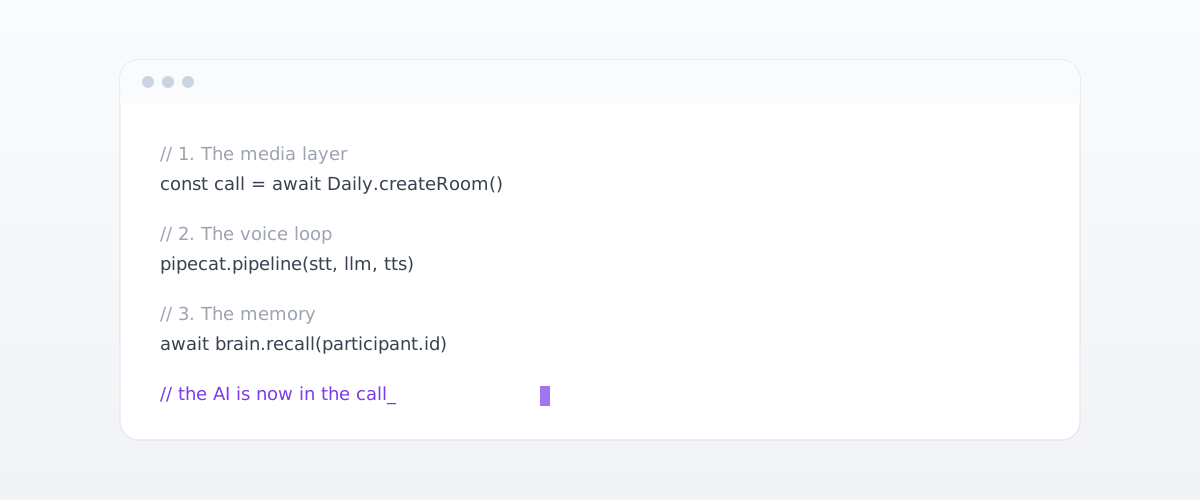
A practical, opinionated guide to building video calls where AI is a participant — not a notetaker. The four layers (media, voice loop, memory, action), the latency budget, the reference stack, and the hard problems most build posts skip.
AI-Native Meetings and Video Calls
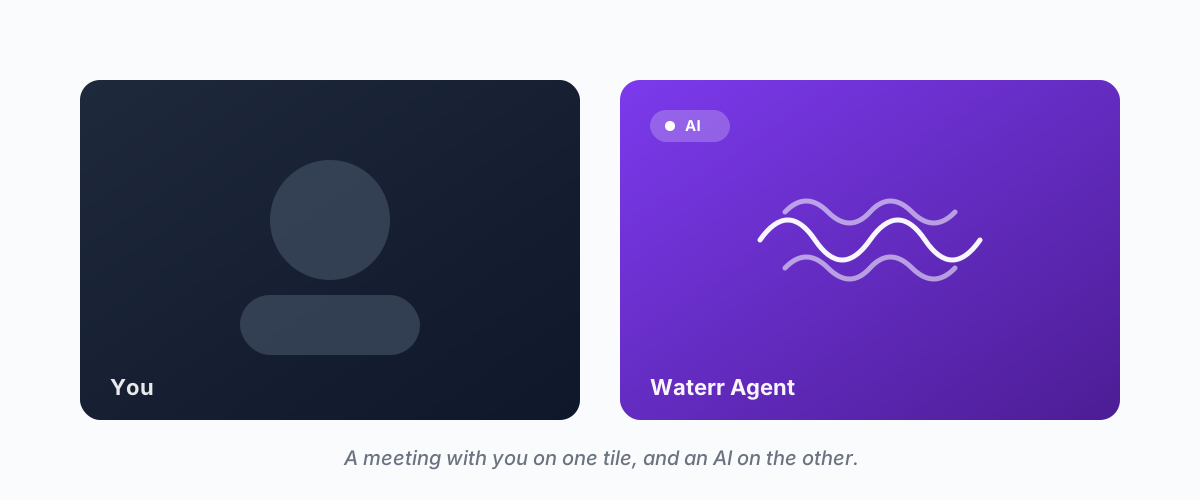
A meeting used to be a place. Then it was a URL. The next thing it becomes is the first interface where the AI sits across from you, not next to you. A piece on what changes when AI stops being a notetaker and becomes a participant in the loop.

Activation Steering for Personality Alignment in Meeting Simulation
A research note on representation engineering — modifying a transformer's internal activations at inference time using sparse autoencoders, contrastive activation addition, and SAE-derived steering vectors — and what the published evidence suggests about applying it to persona alignment in long-horizon meeting simulations.

Plus One for Developers
"Quick call?" is the most expensive lie in software. It looks like 15 minutes on a calendar. It actually costs the 90 minutes of context you'd loaded into your head — and the hour afterwards trying to claw it back. Plus One takes the call for you, listens to what your PM, designer, or customer actually needs, and hands you back a brief — plus a prompt ready to drop into Claude Code.

Async Video Meetings: The Default Coordination Layer
Async video meetings are the highest-bandwidth way humans transfer context — without forcing everyone into the same 30-minute window. Plus One turns every scheduled call into an async video meeting on your permanent waterr.ai/your-username link.

Introducing Plus One
Every person gets a personal EA with its own permanent link - waterr.ai/your-username. Share it like an email address. Anyone you allow can open it and jump on a live 1:1 call with your context, anytime, without touching your calendar.
Your Personal Harness for a Team of Agents
AI without context is just autocomplete. A unified harness that knows your world — your people, your tools, your patterns — turns a team of agents into an extension of you.

AI Meeting Privacy: How Waterr AI Keeps Your Calls Yours
AI meeting privacy is usually an afterthought — the recording, transcript, and analysis end up on someone else's servers by default. Waterr AI is built the other way around: local-first, encrypted, and with a PII shield between your meetings and every AI model that touches them.

Video AI Agents: Why the Video Call Is the Next Frontier
A video AI agent isn't a chatbot with a face — it's an AI that sees, listens, and responds inside a real video call. Text gives AI words. Audio gives it tone. Video gives it everything — expression, attention, body language, environment. The companies that ship video AI agents will define the next platform.

Build Your World Model — Why a Digital Brain Changes Everything
Your knowledge is scattered across 12 apps, 47 tabs, and hundreds of conversations. A unified digital brain doesn't just organize it — it makes AI actually useful.